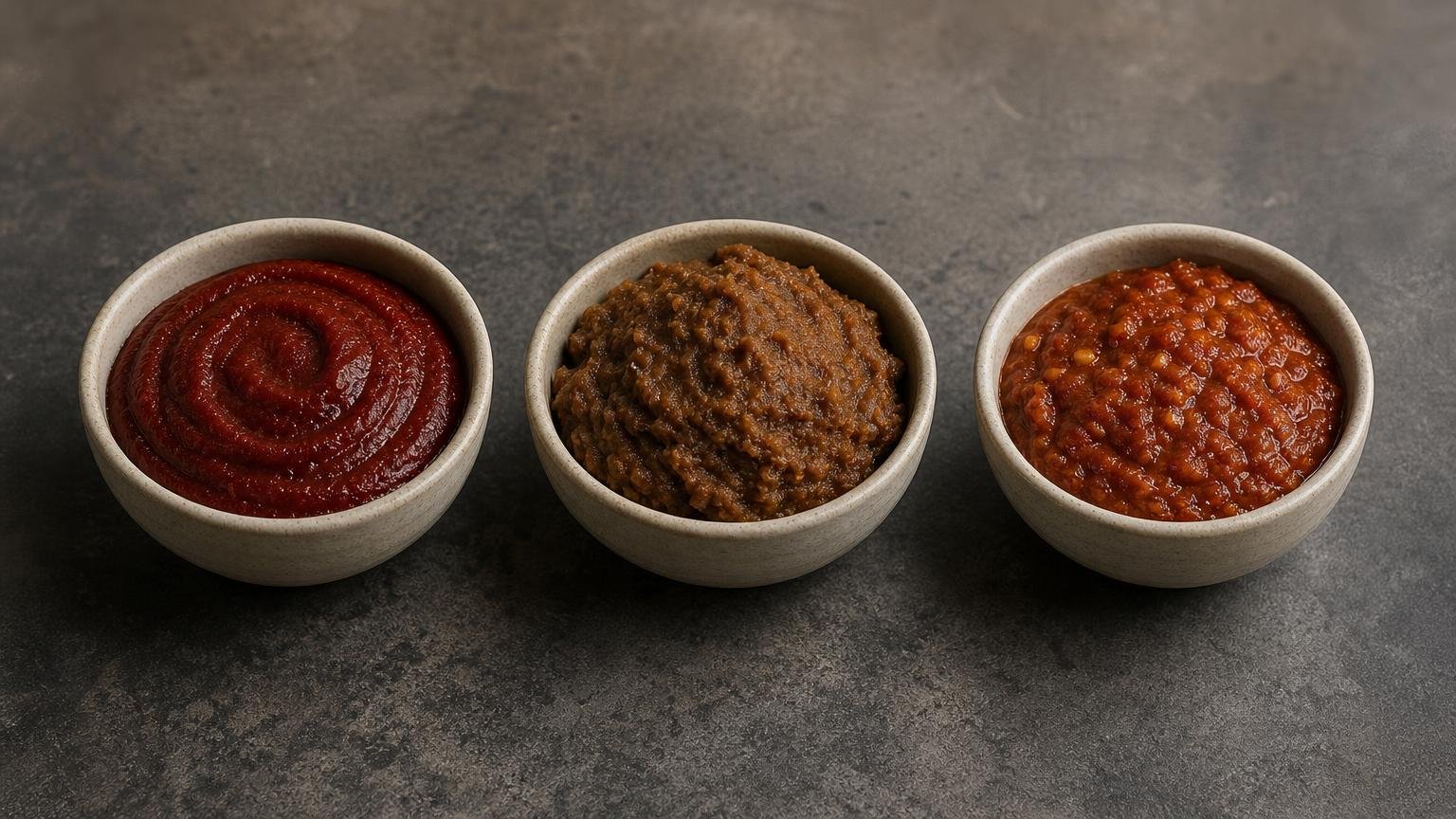
Gochujang brings chili heat, doenjang delivers deep soybean flavor, and ssamjang offers a prepared dipping condiment. Here is how to choose the right jar for your kitchen.
Key Takeaways
- Gochujang is the chili-forward choice for spicy marinades, stir-fries and dips.
- Doenjang provides robust fermented soybean flavor suited to soups and stews.
- Packaged ssamjang is a convenient, seasoned condiment for grilled meat, vegetables and lettuce wraps.
- Ingredients, heat, sweetness and allergens vary, so check the current product label.
Gochujang, doenjang and ssamjang may occupy the same supermarket shelf, but they serve different purposes. Choose gochujang when you want a thick, spicy fermented condiment; doenjang when a dish needs robust soybean flavor; and ssamjang when you want a prepared paste for grilled meat, vegetables or lettuce wraps.
The quick answer
- Buy gochujang for spicy marinades, stir-fries and dipping sauces. Its characteristic flavor combines heat with savory, salty and potentially sweet notes.
- Buy doenjang for soups, stews and other dishes that need a strong, umami-rich fermented soybean base.
- Buy ssamjang if your priority is a convenient, ready-to-eat accompaniment for grilled meat, vegetable sticks, rice or lettuce wraps.
There is no universal winner. The useful question is whether you need chili heat, concentrated soybean flavor or a prepared table condiment.
What is gochujang?
Gochujang is a fermented red or dark-red paste made with grains, red-pepper powder, salt and water. Its production includes grain saccharification, salting, fermentation and aging. The Codex standard distinguishes it from an ordinary chili paste or chili sauce.
The Korean Food Promotion Institute describes traditional gochujang as a combination of red-chili powder, glutinous rice, powdered meju and salt. Modern packaged versions can have more complex formulas. One Sempio product, for example, contains rice, red-pepper powder, salt and soybean along with corn syrup, wheat-derived ingredients, alcohol and seasonings.
What does gochujang taste like?
Expect a thick condiment with savory, spicy and sweet characteristics. Exact heat and sweetness vary by product, so do not assume that every tub will taste the same.
When should you buy it?
- You want red-chili heat as well as fermented flavor.
- You regularly make stir-fries or marinades.
- You want a thick paste that can also be used for dipping.
What is doenjang?
Doenjang belongs to the broader category of fermented soybean pastes. Under the relevant Codex regional standard, soybean is the essential ingredient. Production involves fermenting boiled or steamed soybeans, optionally with grains, before combining them with salt or brine and aging them.
The Korean Food Promotion Institute describes traditional doenjang as the soybean paste produced by further fermenting the meju solids removed after brine fermentation. Commercial formulations can differ: grains, sugars, starch syrup and natural flavoring materials are among the optional ingredients permitted within the broader Codex category.
What does doenjang taste like?
Sempio characterizes its doenjang as robust and rich in umami. Unlike gochujang, the defining ingredient is soybean rather than red pepper.
When should you buy it?
- You primarily want a base for soups or stews.
- You prefer pronounced fermented soybean flavor over chili heat.
- You want a paste that can also be used in marinades, stir-fries, wraps or barbecue dipping sauces.
What is ssamjang?
Ssamjang is the most immediately condiment-like choice in this comparison. Sempio describes its packaged version as a prepared blend of soybean paste, red-chili seasoning, sesame and vegetables. That combination produces a savory, sweet and mildly spicy paste intended to be eaten with grilled meat, vegetable sticks, rice and lettuce wraps.
This description applies to that particular product rather than every ssamjang on the market. Formulas can differ, so the ingredient list remains important when comparing brands.
When should you buy it?
- You want a ready-to-eat paste for lettuce wraps.
- You need a convenient accompaniment for grilled meat or raw vegetables.
- You prefer a savory, mildly spicy condiment rather than a more chili-forward paste.
Gochujang vs. doenjang vs. ssamjang at a glance
- Defining character: Gochujang is red-pepper-forward; doenjang is soybean-forward; packaged ssamjang combines soybean paste with seasonings as a prepared condiment.
- Flavor direction: Gochujang is spicy, savory and often sweet; doenjang is robust and umami-rich; the cited ssamjang is savory, sweet and mildly spicy.
- Typical role: Gochujang suits marinades and stir-fries, doenjang suits soups and stews, and ssamjang suits dipping and wraps.
- Convenience: Ssamjang is the clearest ready-to-eat option among the three, while gochujang and doenjang are frequently used as components in cooking.
Check the label before buying
Traditional descriptions do not capture every commercial formula. In the cited Sempio range, the gochujang and doenjang declare wheat and soybeans as allergens. Its ssamjang declares wheat, soybeans and sesame. Those declarations are product-specific and should not be applied to every brand.
Sweetness and nutrition can also vary. For example, the cited gochujang lists 5 grams of sugars per 18-gram serving, while the ssamjang lists 8 grams per 40-gram serving. The cited doenjang lists no sugars per 30-gram serving. Because the serving sizes differ, the numbers should not be compared directly without converting them to the same weight.
Check the current package and linked official product page if allergens, sugar, sodium or other dietary considerations affect your choice. Recipes and product information may change.
What This Means
If you are buying only one paste, start with the food you intend to make. Pick gochujang for spicy marinades and stir-fries, doenjang for soybean-rich soups and stews, or ssamjang for a prepared accompaniment to grilled foods and wraps. Buying all three is not redundant: each provides a different balance of heat, fermentation, seasoning and convenience.
Sources
- Codex Alimentarius — Standard for Gochujang (CXS 294-2023)
- Codex Alimentarius — Regional Standard for Fermented Soybean Paste (Asia), CXS 298R-2009
- Korean Food Promotion Institute — Correct Notation of Korean Menus in Foreign Languages: Jang
- Sempio — Gochujang, Korean Chili Paste
- Sempio — Doenjang, Korean Soybean Paste
- Sempio — Ssamjang, Korean Soybean Dipping Paste
